
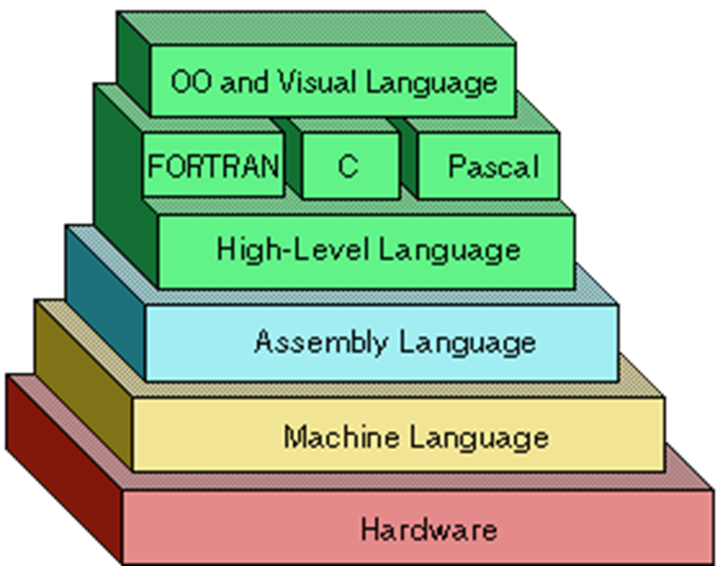
Low-level: Machine code (binary code), Assembly...
Hight-level: JavaScript, Python, Java, Visual Basic, Perl, Ruby, C#, and many others...


A continuación se muestran una imágenes interactivas de los principales conectores de la PLACA BASE y del panel ENTRADA/SALIDA
Componentes:
- ENTRADA (sensores)
- CONTROL (tarjeta controladora)
- SALIDA (actuadores)
Tipos:


Create a blog using "blogger". Follow these instructions:
- Access to blogger with your account @gmail.com
- Blog's URL: xxxxdigramiro.blogspot.com (xxxx=student's number)
- Blog's title: Digitalization 4th ESO Name
- Go to "Configuración" and change the language of your blog into English
PRIVACY: - Go to "Settings" now, and disable the option to be visible to search engines and in the PERMISSIONS section, change Reader Access from "public" to "custom readers". Then invite the teacher adding this email address: profesorticramiro@gmail.com

- Create an "avatar" with your physical appearance and download the images.
Visit these pages:
- To have access to the class 4PINF2025 follow this link: https://login.pixton.com/jhzwzx
http://www.pocoyo.com/en/pocoyizeyourself


- For this first post in your blog "01.Introduction" write a presentation about yourself and what for are you using this blog. Also explain your previous knowledge and experience with computers and other devices. You can use these questions to help you...
Do you have a laptop or tablet for yourself at home? Do you share with your family? How many hour per day/per week do you use a computer at home? How many hours do you spend with your smartphone? Do you think you are adicted to your phone or social media? What do you think about the new rules about the phone at school? Do you know something about programming? Do you have any experience with programming? Why did you choose this subject? Do you like computers and programming?
Add the image of your "avatar" in this post
- Finnaly add a gadget in the side of your blog that will be title as LINKS OF INTEREST and here you add the teacher's blog and so far, pixton and pocoyize website. Here, you will have to publish the link of every application we use!!

- Contenidos y Evaluación
- Book >>> Donostiarra (978-84-7063-658-5 Tecnología y Digitalización 3º – Proyecto STAR)
- Prueba inicial (Fotocopia)
+ Cuaderno
- Contents and Assessment - link
- Book >>> Donostiarra (978-84-7063-660-8 Technology and Digitalisation 3º ESO – Project STAR)
- Initial Test (Photocopy in Spanish) - - Translate the answers into English
+ Notebook
PINF : Programación Informática
Programming - Coding



A) Open Scratch and, after logging in, create a program where the cat (Sprite) does the following actions when the green flag is clicked:
Say "Hello" for 2 seconds.
Move 100 steps to the right and wait 1 second.
Ask: "Can you help me?"
If your answer is yes: say "Thanks" for 2 seconds.
If your answer is no: say "I had to try."
Finally, say "See you soon."
Presentación de Contenidos ---- Cuadro Programación
ACTIVIDAD 1
Crea tu blog con blogger, siguiendo estas instrucciones:
- Accede a "blogger" desde tu cuenta de gmail
- URL del bog: xxxxdigramiro.blogspot.com (xxxx=tu nombre)
- El título del blog será: Digitalización 4ºESO de xxxx (tu nombre)
- Personaliza tu blog de tal forma que se vea el contenido completo de cada entrada sin necesidad de entrar en ella.
- Accede a las opciones de configuración para que el blog sea privado y crea una invitación para la profesora añadiendo la cuenta de correo: profesorticramiro@gmail.com
- Crear un "avatar" que se parezca a ti y publícalo como imagen en tu blog. Visita estas páginas:
ACCEDE AL GRUPO DE CLASE 4DIG2025 A TRAVÉS DE ESTE ENLACE:
https://login.pixton.com/vcy9cx
http://www.pocoyo.com/en/pocoyizeyourself
Añade la imagen de tu "avatar" en esta entrada
- Por último añade a la derecha un gadget que titules ENLACES DE INTERÉS en el que incluyas por el momento los enlaces a las web de pixton y pocoyize, así como al blog de la profesora. En este gadget tendrás que ir publicando todos los enlaces de aplicaciones que utilicemos a lo largo del curso.
Historia y evolución de los robots
Visualiza el vídeo y responde a las siguientes preguntas:
1. **¿Qué es la robótica?**
- Minuto: 00:03 - 00:14
2. **¿Para qué se usaba el robot Unimate?**
- Minuto: 00:56 - 01:03
3. **¿En qué industria se adoptaron primero los robots industriales?**
- Minuto: 01:42 - 01:58
4. **¿Por qué los primeros robots con inteligencia artificial tenían capacidades limitadas?**
- Minuto: 02:04 - 02:35
5. **¿Qué tecnología permitió que los robots aprendieran y mejoraran con el tiempo?**
- Minuto: 03:21 - 03:26
6. **¿Qué permite la visión por computadora en los robots?**
- Minuto: 03:51 - 04:02
7. **Menciona un robot doméstico que ayuda en las tareas del hogar.**
- Minuto: 05:29 - 05:41
8. **¿Cómo ayudan los robots en los hospitales?**
- Minuto: 07:23 - 10:24
9. **¿Qué ventajas tienen los robots en las cirugías?**
- Minuto: 08:03 - 08:33
10. **¿Qué futuro se espera para los robots en la salud?**
Presentación de contenidos - programación -
Prueba inicial de comprensión lectora sobre temática de robótica e inteligencia artificial.
Jugamos con robo
Recordamos Scratch

NO OLVIDÉIS ESTA PUBLICACIÓN QUE DEBÍA ESTAR HECHA DESDE EL 20 DE MAYO!!!
Realiza una publicación que resuma los principales archivos y programas para trabajar con archivos multimedia de imagen, audio y vídeo. Inserta imágenes de los logos de los programas más utilizados y explica la diferencia entre imágenes mapa de bits y vectoriales. Puedes guiarte por este esquema:

This video from Appliancepreneur explores the essential role of sensors and actuators in robotics. Sensors, like LiDAR*, ultrasonic, infrared, and vision systems, allow robots to perceive their environment by detecting light, distance, touch, and more. Actuators enable robots to move and interact physically, using electric motors, hydraulic, pneumatic, or soft actuators depending on the task. Together, sensors and actuators create feedback loops that let robots perform precise, adaptable tasks across industries such as manufacturing, healthcare, autonomous vehicles, and agriculture. The video highlights ongoing advancements and challenges in robotic sensing and movement, emphasizing their importance for future innovations.
*LiDAR (Light Detection and Ranging) is a remote sensing technology that uses pulsed lasers to measure distances and create highly accurate 3D models of environments
Buenos días chicos, en la clase de hoy que yo no voy a estar quiero que os aseguréis de que tenéis subidos en ivoox y publicados en vuestro blog los 3 ejercicios de audacity:
1.-mix de canciones- enlace a instrucciones
2.-cuento con música- enlace a instrucciones
3.-cuña publicitaria - enlace a instrucciones
Si ya lo habéis terminados podéis empezar a trabajar con GIMP (asegúrate que lo tienes instalado y si no búscalo en el centro de software e instálalo)

Sigue las instrucciones del primer ejercicio paso a paso aquí
Descárgate las imágenes para los ejercicios aquí

